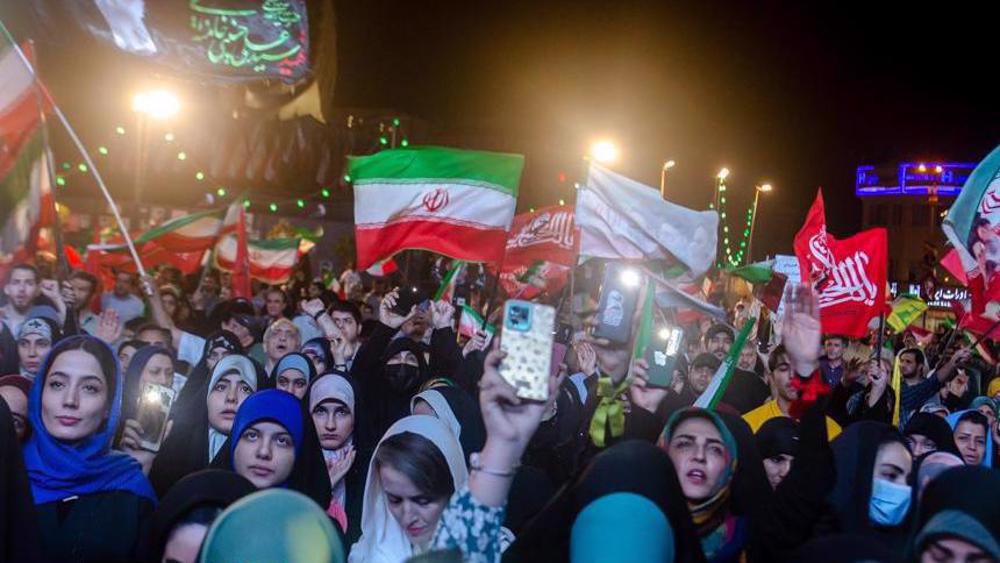
Senior Iranian military and security officials have praised 200 consecutive nights of nationwide demonstrations in support of the country’s armed forces, describing the continued public presence as a sign of national unity and domestic strength.
Messages from the leadership of the Supreme National Security Council, the Islamic Revolutionary Guard Corps and the Iranian Army emphasized the role of public support in strengthening Iran’s deterrence against external pressure from the United States and Israel.
According to the officials, the demonstrations represent a major turning point in Iran’s recent history and have challenged expectations that military pressure could create internal divisions or weaken public resistance.
Supreme National Security Council Highlights National Unity
Major General Mohsen Rezaei, secretary of the Supreme National Security Council, said the 200-night mobilization should be viewed as more than a security response.
In his message, Rezaei referred to Iran’s history of foreign invasions, occupations and outside intervention. He argued that a lack of national cohesion had contributed to defeats, unequal treaties and territorial losses during earlier periods.
Rezaei said the continued presence of the Iranian public demonstrated a strong commitment to the country and its independence. He described national unity as one of the most important pillars of Iran’s deterrence and said the demonstrations had challenged narratives based on internal division.
He also stated that military and economic pressure had failed to weaken the public’s resolve.
IRGC Describes the Rallies as a National Awakening
Major General Ahmad Vahidi, commander-in-chief of the Islamic Revolutionary Guard Corps, described the nationwide gatherings as a “national awakening” and a renewed expression of public solidarity with the country’s leadership.
Vahidi warned that, after military confrontation, the United States and Israel could increasingly rely on what he called cognitive warfare, economic pressure and attempts to create public fatigue.
He urged the population to respond by supporting domestic production, strengthening the national economy and developing scientific and technological capabilities.
The IRGC commander also reaffirmed the force’s stated commitment to defending the country and responding to what Iranian officials describe as attacks against Iran.
Army Commander Points to Iran’s Internal Strength
Major General Amir Hatami, commander-in-chief of the Iranian Army, said the demonstrations had highlighted what he called the “internal structural strength” of the Islamic Republic.
According to Hatami, the continued public presence had affected hostile military planning and psychological operations. He said Iran’s power was based not only on the capabilities of its armed forces, but also on public support, faith and national unity.
Hatami reaffirmed the Army’s commitment to defending Iran’s territorial integrity and national interests.
How the Nightly Demonstrations Began
The nightly gatherings reportedly began after the outbreak of large-scale fighting on February 28. Initial gatherings were described as spontaneous expressions of grief and anger following attacks on Iranian cities and civilian infrastructure.
By early March, similar events had reportedly developed in major cities as well as in other provinces. Participants gathered in public squares and other open spaces after sunset, often carrying national flags, lighting candles for those killed and chanting slogans against foreign pressure.
Iranian state-linked media have presented the demonstrations as serving two main purposes. First, they are described as a way to boost the morale of soldiers and their families. Second, they are portrayed as a public rejection of political, economic and psychological pressure from abroad.
The Broader Political Significance
The continued demonstrations have become part of the Iranian authorities’ effort to present an image of domestic cohesion during a period of military and diplomatic tension.
The statements from senior officials also show that public support is being linked to wider questions of national security, foreign negotiations and regional stability.
However, independent and comprehensive information about the size of the gatherings, the social composition of participants and the views of different groups across Iran remains limited. As a result, the official description of the demonstrations should be understood as the position of Iranian authorities rather than as a complete representation of all public opinion in the country.
What This Means for Travelers to Iran
For travelers considering a visit to Iran, the wider regional security situation remains more important than the demonstrations themselves.
Travel conditions may be affected by changes in flight schedules, border procedures, intercity transport, local security measures and access to certain destinations. Travelers should check official travel advisories, confirm transport arrangements and remain prepared to adjust their itineraries if conditions change.
YA PERS continues to follow developments that may affect travel routes, tourism services and access to Iran’s major destinations.